Saturday, August 30, 2008


Positive Youth Development


Overview
A new dynamic approach to learning in schools is emerging from chrysalis. And like a butterfly it has two wings carrying it aloft. I refer to the recognition that academic knowledge must be balanced with life knowledge, hard skills with soft skills, head with heart, and individual sensibility with that of the group.


Positive Youth Development is a helpful rubric for describing a wide range of initiatives designed to foster emotional and social intelligence along with more traditional education goals. These have emerged in response to a crucial gap perceived by practitioners in schools and youth
agencies. Simply put, learning is a social process within which human emotions and relationships are powerful intrinsic influencers.

This is a relatively new field and hi
ghly interdisciplinary. Moreover, each of these initiatives has a distinct theoretical framework, methodology, and ecosystem of institutions and practitioners. The Social Development Research Group at the University of Washington has identified 161 PYD programs. Some 3 million young people have been involved in related research projects across North America [Search Institute].


PYD is part of an even broader shift in psychological theory, research, and praxis. Related developments include Positive Psychology, Positive Scholarship, and Appreciative Inquiry. These all share a common perspective. That is, that the positive images we create and share - of ourselves, of each other, and our futures - help drive their actualization.


"As you ramble through Life,
Whatever be your goal.
Keep your eye upon the doughnut,

And not upon the hole."

What Parents Are Saying
Teaching social skills has tremendous importance for the nearly 1,000 people surveyed by Hasbro. 90% of parents consider social skills to be vital to their children's happiness and confidence and nearly 80% consider these more important than academic skills when it comes to happiness.


Social and Emotional Learning
SEL is an umbrella term used to describe the skills needed “to recognize and manage emotions, develop care and concern for others, make responsible decisions, establish positive relationships, and handle challenging situations effectively" (CASEL) SEL has grown increasingly important within primary and secondary schools across Canada and the United States.

Developmental Asset Framework

This framework developed by the Search Institute outlines those ‘assets’, or ‘development building blocks’ essential to the health and well being of Middle and High School students. Young people draw on these assets to make positive choices, avoid high-risk behaviors, and thrive. Internal Assets include competencies and values that young people learn and internalize on their way to becoming responsible and healthy adults. External Assets consist of resources like friends, family, mentors, school, and community organizations.

Resilience Education
Resilience Education is concerned with how some youth, despite terribly challenging lives, are able to overcome adversity and thrive. Research has identified these core characteristics and strengths, which are key to healthy development and effective learning. “Changing the life trajectories of children and youth from risk to resilience starts with changing the beliefs of the adults in the families, schools, and communities”. [Benard, Bonnie 2004, Resiliency: What We Have Learned. San Francisco, CA: WestEd]

Character Education
Character Education is an umbrella-term used to describe the teaching of children in a manner that will help them to develop. Concepts that fall under this term include social and emotional learning, moral reasoning/cognitive development, life skills education, health education; violence prevention, critical thinking, ethical reasoning, and conflict resolution and mediation. This form of education involves teaching children and adolescents’ values including honesty, stewardship, kindness, generosity, courage, freedom, justice, equality, and respect.

Positive Behaviour Support
PBS is the application of evidence-based strategies and systems that work at an individual level and school wide level. This is designed to help establish a positive and safe environment, which in turn is conducive to increased academic performance.

“One of the wonderful features of a “PBS School” is that the ... selection of interventions and programs is often done collaboratively by a school team ... Positive Behavior Support is different from traditional behavior modification in three ways. First, it is focused on the use of positive intervention strategies that are respectful of the individual. Second, the interventions that are developed are individualized and are based on an understanding of the individual, the individual’s communication abilities, and the unique situations of the individual. Third, the intervention strategies that are developed are focused on helping the individual gain access to new environments, have positive social interactions, develop friendships, and learn new communication skills.”

School Climate
School Climate is another term with a fairly broad definition. In essence, school climate refers to the overall quality and feel of the attitudes, feelings, and behaviours of individuals - students, teachers, administrators, staff. School climate establishes the bounds of acceptable behaviour among all stakeholders, and all are deemed responsible for its maintenance. There are four overlapping relation fields.
  • The relationship of a student to her or himself
  • A student to her or his peers
  • A student to her or his parents and community
  • A student to her or his school workers, including teachers, administrators, and all staff

Thursday, August 28, 2008


Visual Thinking Is A Snap


The following article from
eSchool News caught my eye. It's worth noting that in 2008 alone over 110 million digital cameras will be sold worldwide.

Montpelier High School Principal Peter Evans was meeting with a parent recently when the conversation turned to technology in the classroom, reports the Times Argus of Vermont. What is the school's policy on the use of electronics--iPods, MP3 players, PDAs, digital cameras, and laptops--in class, the father asked Evans. He had been opposed to students using tech devices, the dad told Evans, until he saw his son pull out a cell phone while he was working on his homework one night. The teenager explained that he hadn't had a chance to copy down math equations on the board at the end of class, so he used his phone to snap a picture of it. That really changed [the dad's] mind about how wise kids are using technology.

Saturday, August 23, 2008


On Visual Thi
nking

We think in pictures and words and we use both to communicate. We also tend to favour one cognitive style over the other, just as cultures do. Since the advent of the printing press, the written word has had the upper hand in western society, to mangle a metaphor. This is now changing rapidly.

Thanks to easy-to-use inexpensive computers, digital cameras, and high speed Internet, there’s been a profound upsurge in our society’s capacity to think and communicate visually. The following lists a few ways this is manifesting. As Dan Roam, The Back of the Napkin, observes: Drawing things out helps us look, see, imagine, and show ideas that would have remained hidden had we not picked up the pen.

Visual Thinking & Education

Thinking Through Stone
My own study of visual thinking began in earnest in the early 90s. For my doctoral fie
ldwork, I lived two years in a remote village in western Kenya. Tabaka is the epicenter of a century-old soapstone carving cottage industry. My research focused on how one generation of carvers transferred their visual knowledge to the next generation. Of course, this was largely non-verbal, indirect, and informal. It’s an interesting process to try to externalize a creative visual activity. There’s an entire literature and methodology on this subject. Vera John-Steiner’s Notebooks of the Mind is an exemplar.


Visual Spatial Learners
A significant number of students are
visual spatial learners. Dr. Linda Kreger Silverman’s research and website are a tremendous resource. Slightly over half of all early school leavers have a visual spatial orientation. Dr. Silverman makes a powerful case that these young people could be and should be taught to their strengths. -

A computer is as indispensable to the visual-spatial child as a book is to an auditory-sequential child. It is visual, graphic, unconcerned with time, highly motivating, responsive to the inquisitive mind of the visual-spatial learner, and accesses the right hemisphere. It is the skating rink where a visual-spatial mind can perform dazzling feats ... Success in our technological era depends upon different skills than are currently emphasized in school: visualization, grasping the big picture, multi-dimensional perception, pattern finding, thinking graphically, and creativity.

New Innovation: Picturing To Learn
There’s a remarkable pilot program underway called Picturing To Learn through the aegis of Harvard and MIT. One of the co-founders, Felice Frankel, states that ‘visually explaining concepts can be a powerful learning tool.’ Part of the reason is that creating a picture can reveal connections that words alone may not. It fosters a holistic perspective and the ability to tell a complete story. When used to help high school students learn and express scientific concepts, the most amazing results occur. Ms. Frankel and her colleagues have already developed a database with more than 4000 drawings.


Visual Communication Tools

Paper & Pencil
We've been creating images to communicate from the start. The drawing featured below was created in Lascaux 17,000 years ago. How easily we can 'read it' today. The means to communicate visually are almost always at hand. What a profoundly simple and immediate way to convey so much at once.


Mind Maps
A mind map is a diagram used to represent words, ideas, tasks, or other items linked to and arranged radially around a central key word or idea. It is used to generate, visualize, structure, and classify ideas, and as an aid in study, organization, problem solving, decision making, and writing. There are many variations of this mapping process, for example Concept Maps and Semantic Maps. Each has its own centre of gravity, protocols, and practitioners. Mo st have software equivalents too.


Graphic Facilitation

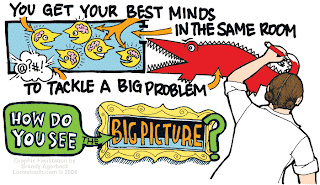
Practitioners help groups better picture what they are thinking and trying to express to each other.
They are skilled in literally drawing out the groups’ thoughts and feelings as they emerge through guided dialogue. The results can be very impressive. A graphic facilitator generally works with marking pens on a large (4-feet-high and 10-to-15-feet-long) sheets of butcher paper.


Image Maps
An image map is an online tool featuring one overall diagram with specific parts hyperlinked to relevant destinations. The example here is from the emerging field of Positive Psychology. As its creator’s note, these image maps can help people get a mental structure for storing information about positive psychology, and the attached articles form a reader’s guide for learning about the subject.


Interactive White Boards

This large interactive display enables an individual or group to write or draw on the surface, print off the image, save it to computer or distribute it over a network. Images can also be projected on the screen from a computer and worked on a life size scale, which in turn is recorded on the computer. SMART Technologies, a Canadian based producer of interactive whiteboards alone generates about a billion dollars in revenues.


Surface
Microsoft Surface is a 30-inch display in a table-like form factor that several people can use simultaneously. The intuitive user interface works without a traditional mouse or keyboard, allowing small groups to interact with visual content and information in a more natural and familiar way, by using their hands, gestures, and creativity.


Vision Boards

This is an interesting trend that takes the dynamics of visual thinking to another level. Vision Boards are just that, boards on which people draw or collage images of their goals and dreams. It is believe by practitioners that creating a vision board and using it as meditation will help their goals and dreams to materialize. As with practically every other tool, a community of practice and ecosystem of enterprise has evolved. There are software companies offering a streamlined online digital approach as well. I will revisit the related practices of visualization and imagineering in another post. Suffice it to say there’s extensive research underscoring the value of these processes.


Black Boards


Friday, August 22, 2008


T
he force that through the green fuse drives the flower
Dylan Thomas


Saturday, July 12, 2008


The Kaleidoscope


Sir David Brewster invented the kaleidoscope in 1816 while conducting experiments on light polarization. Its name derives from the ancient Greek kalos ‘beautiful’ and eidos ‘form’. This optical device is made from ‘tube containing mirrors and pieces of colored glass or paper, whose reflections produce changing patterns that are visible through an eyehole when the tube is rotated’. It became a social phenomenon. In 1818 Blackwood's Magazine stated that: " no invention, and no work, whether addressed to the imagination or to the understanding, ever produced such an effect." Hundreds of thousands, perhaps millions were purchased in the course of the century. Some adjectives that describe its effect – psychedelic, polychromatic…. ever-shifting, fluid, fluctuating, unpredictable, impermanent.

Sunday, August 19, 2007


The
Golden Gavel

My grandfather was an ornamental ironsmith. He created the gavel pictured here alm
ost a century ago. I’ve always loved its simple, powerful design and balanced heft. Gilded iron. His creative spirit, will, and skill are enfolded into its very materiality.

Iron is heavy and dense due to rigidly ordered, closely aligned molecules. Water, by way of contrast, consists of volatile, random molecules with lots of space between them. Smiths heat the iron to loosen up the rigid molecules. It becomes more malleable and therefore easier to work with.

Like iron, our thinking can sometimes be dense and rigid. It needs to be loosened up if we want to forge something new and better. The h
eating and hammering is an apt metaphor of the psychic processes entailed.

Blacksmiths: Magicians of Transformation
In many cultures, ironsmiths are also diviners, priests, and healers. They were often feared as much as revered for their skill in transforming inert metal through fire and force into tools and weapons for life and survival. For example, in Dogon myth, it was the blacksmith who brought fire to earth for the first time. Among many Mande cultures, blacksmiths are called

The First Sons of the Earth. They are associatedn always present at the forge: fire, air of the bellows, water, and earth. In this setting they are thought to harness the forces or energy of nature (called nyama) to transform materials of the earth into tools, art, and ritual objects"

This idea is also found in the Judeo-Christian tradition. Tubal-Cain is refer
red to in the King James Bible as a master artificer of iron weapons and tools. In the 1850s, the Scottish poet and songwriter Charles Mackay wrote his famous verse .

Old Tubal Cain was a man of might
In the days when earth was young:
By the fierce red light of his furnace bright
The strokes of his hammer rung;
And he lifted high his brawny hand
On the iron glowing clear,
Till the sparks rush'd out in scarlet showers,
As he fashion'd the sword and spear.
And he sang - "Hurrah for my handiwork!
... And the red sparks lit the air;
"Not alone for the blade was the bright steel made;"

And he fashion'd the first ploughshare!


The Great Hammering
In Alchemy there are several stages involved in transmuting a base metal into gold. The fourth stage - Sublimatio - has also been described as a great grinding down to rhinisima, refers to the micro filings that result. It’s this ultra fine powder, almost gas, which is key to the final step of transformation. This idea is also echoed in Norse Mythology. The Norse believed that Thor, the god of thunder and lightning, wielded a hammer called Mjolnir. It’s Indo-European root mel means to crush or grind. In turn, it’s related to the Latin malleus, for hammer, as well as the Latin mola, for mill.

Sunday, May 27, 2007


The Whole Picture

A word’s meaning
evolves over a long period of time. Tracing its roots can be revealing. Seemingly disparate words often share common roots and import. Such is the case with synapse, yoga, algebra, and art. Each in its own way denotes joining things together to create greater wholes.

Synapse
It’s apt to sta
rt with this biological term as millions of mine and yours are sparking now as I write and you read! A synapse is like a junction. It facilitates the exchange of electrical signals from nerve cells via interconnected circuits throughout the central nervous system. Young children have some 1,000 trillion in their brains. As we age, this declines. Most adults have between 100 and 500 trillion synapses. Through this synaptic activity, biological impulse is magically transmuted into perception and cognition.

The te
rm is derived from the ancient Greek synapsis meaning conjunction. It was first coined in the late nineteenth century by the British physiologist Sir Michael Foster. It gained wider exposure through his student, Sir Charles Sherringon, who won the 1932 Nobel Prize in Medicine and Physiology.Apse is a related architectural term. Both stem from haptein, which originally meant joining arcs to form a circle, especially in reference to wheel making.

Yoga

Yoga is an ancient Indian practice, dating back to 2500 BCE, possibly even earlier. Its name derives from the Sanskrit yuga, which means to join, or yoke together. A yoke is a wooden bar that fits over the necks of animals to pull a cart or plow. Generally associated with servitude, the yoke once had a more positive social meaning. In Old English, for example, it meant a bond of partnership or cooperation. The goal of yoga is to yoke our temporal being to the divine imperative, just as the oxen is yoked to the higher purpose of drawing the plow.

Algebra
Algebra is
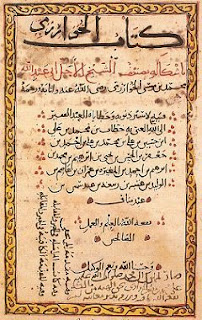
concerned with that branch of mathematics in which symbols, usually letters of the alphabet, are used to represent unknown numbers. In 830 CE, Al’Khwarizmi wrote Hisab al-jabr w’al-muqabala, or The Compendious Book on Calculation by Completion and Balancing, from whence algebra got its name. In Arabic, Al-Jabr means the reunion of broken parts. Al’Khwarizmi also developed the concept of algorithms so crucial to computational technologies today. In an earlier post I discuss how Fibonacci introduced the term zero to the West. His source was Al’Khwarizmi. Al’Khwarizmi also led a team of seventy geographers to calculate the earth’s circumference and develop a world map.

This idea of measured calculation is also expressed by the term ratiocinate, to reason methodically with precise logic. Its root is the Latin ra, which means to fit together. Ra in Latin is actually a transposed Ar. We will come back to Ar below. This transposition between letter and sound, called metathesis, is common in many languages. Of course, there’s always the danger of too much adherence to strict reason and logic. Shaw describes one his characters in 'Androcles and the Lion' as an “inveterate Roman Rationalist, always discarding the irrational real thing for the unreal but ratiocinable postulate".

Art
The Latin root ar
means to join together. Related terms include arm, artery, are, article, and articulate. Art is another related term. However, in its definitions there aren’t any related to the idea of joining things together. It’s actually there but hidden. Between the Middle Ages and Renaissance, education was largely the Church’s purview. It was the only institutional steward of knowledge in the West after the fall of the Roman Empire. It took several centuries to rebuild civil authority and society. During this period, the Church continued to use Latin, the empire’s lingua franca, throughout Europe and the British Isles. It also established universities in the larger cities.

The curriculum then co
nsisted of several required ‘branches’ of learning (called the Trivium and Quadrivium respectively). These included mathematics, rhetoric, music, and philosophy. A student who successfully completed the entire course graduated as a Master of the Arts. One could have easily called him or her Master of Joinery. For that is essentially what they did. They integrated the knowledge gained in each branch within one larger conceptual frame and worldview. The value of artem - this ability to effectively join things together - was widely understood and appreciated, whether in producing good walls, wheels, and scholars। It takes skill and creativity to build something whole and enduring from smaller bits, whether these are stone, wood, or ideas. True then and now.

This calls to mind those master artisans who construct works of great beauty and utility by joining natural elements together. For example, the stonewall mason able to fit rough stone to stone, without cement, so that their walls stand for centuries। Or, consider for example, a furniture wright who joins disparate wood pieces together without nails, so that the piece serves for ages too.

The Greater Conjunctio

Alchemy is concerned with nothing less than the union of opposites, the squaring of the circle, and the rebirth of the phoenix. In its final stage, called the greater conjunctio, all one-sidedness is rectified. Alchemists also called this stage, zygon, which is ancient Greek for the even older Sanskrit yuga, which means, of course, joining. In The Act Of Creation (1964), Arthur Koestler provides a tour de force analysis of the creative process within the arts and sciences. His principle finding is that all acts of creation involve the novel intersection of idioms, concepts, processes, and materials. He developed a conceptual framework called the bisociative pattern of creative synthesis to describe this process.

One of his many examples involves Guttenberg’s quest to create what didn’t exist and had no name। After great challenge and set back, Guttenberg wrote in his journal: What am I to do? I do not know: but I know what I want to do: I wish to manifold the Bible. I wish to have copies ready for the pilgrimage . . .[1964:122]. In his fervent and fertile inventiveness, and through much trial and error, Guttenberg ultimately and ingeniously married together three entirely different manufacturing processes – the manual hand printing of pictures from wood blocks, the metal die casting of standardized coins, and the wine press.

This is bisociation, or Ar, in action.I call yoga, algebra, and art the primary imaginal joints। Each joins things together in its own way. The symbolism of their colors further underscores this, yellow [yoga] for spirit and faith, blue [algebra] for science and reason, and red [art] for creativity and feeling.

E.O. Wilson, the biologist, foresaw the potential integration of the sciences and humanities. In 1998, he introduced the term consilience to describe this “jumping together of knowledge... across disciplines to create a common groundwork for explanation." Seven years later, Bill Gates, a Microsoft founder, refers to consilience in a special essay he wrote for Business Week: These technologies promote "consilience" -- literally, the "jumping together" of knowledge from different disciplines. They help people combine their own ideas with at least some existing knowledge far more efficiently than was previously possible.

Fractal Logic
Tellingly, Mandelbrot derived the term fractal from the Latin fractus for broken, uneven. The fractal is another good term for these times. It’s an irregular or fragmented geometric shape that can be repeatedly subdivided into parts, each a smaller copy of the whole. Fractals are used in computer modeling of natural structures that do not have simple geometric shapes, for example, clouds, mountainous landscapes, and coastlines. They’re used to digitally reproduce complex natural shapes like clouds, coastlines, and mountain ranges. Digital artists also use them to create luminous works of computer art.

Saturday, May 26, 2007


Island in Space

In 1986 I had a chance to visit the Vancouver World’s Fair. The United Nations Pavilion made the strongest impact. I purchased a beautiful publication - Island In Space: Prospectus For A New Idea. This is where I first read Hoyle’s prescient 1948 observation: Once a photograph of the Earth, taken from the outside, is available . . . an idea as powerful as any other in history will be let loose.

Further on in the text, there’s an essay by the astronaut Russell Schweickart. After his 1969 space flight he wrote:

You look down there and you can't imagine how many borders and boundaries you cross again and again ... and you don't even see them. From where you see it the thing is a whole and it is so beautiful ... And there you are - hundreds of people killing each other over some imaginary line that you're not even aware of, that you can't even see ... You realize that on that small spot, that little blue-and-white thing is everything that means anything to you - all history, and music, and poetry, and art, and birth, and death, love, tears, joy, games [1986:10]

The first photo of earth from space I ever saw was on cover of the Whole Earth Catalogue in fall 1969. It affected me from the start just as Hoyle predicted. The catalogue’s founding publisher, Stewart Brand, had first learned about an earth photo taken by a NASA satellite in 1966. In fact, he vigorously lobbied to have the photo released to the public. In a 2003 interview, Brand said he felt it would become a ‘powerful symbol’ of Earth ‘as an island’.

We finally saw our home planet as it is. No escaping the visible fact we live on a ball. The photo also gave new credence and impetus to that old saying what goes round comes round. One-sided, narrow thinking slowly began giving way. Great thinkers from diverse fields - such as Kuhn, McLuhan, Fuller, and Bohm - began creating a new language to help describe such holistic concepts as global village, geodome, paradigm, and holomovement.

It’s almost forty years since that first photo of earth. During this time, ingenious new tools like computers and the World Wide Web have emerged to further catalyze this budding consciousness of the greater whole. And yet such tools have always been available through the ages. For example, Mandalas, Labyrinths, and Medicine Wheels are all designed to help us perceive and live life holistically.

TED Media Director June Cohen states this well: The newest digital technologies are returning us to the most ancient form of media — one in which a natural order is restored; our individual stories take center stage, with the rest of the world as a backdrop.

Birds make their nests in circles; we dance in circles, the circle stands for the Sun and Moon and all round things in the natural world. The circle is an endless creation, with endless connections to the present, all that went before and all that will come in the future. ~ Black Elk


Sunday, May 13, 2007


A
Question of Perspective

In 1948, Sir Frederick Hoyle, the physicist-cosmologist who coined the term ‘the big bang’, predicted that once the earth was photographed, its image would unleash “a new idea as powerful as any in history.” Twenty years later, during their extraordinary flight to the moon and back, the crew of Apollo 8 took that very first snapshot. Only now are we beginning to grasp the full import of this powerful ‘new idea’. With it, we truly see ourselves – that is humanity and life entire – in a global context. As Apollo 8 astronaut Bill Anders said: "We came all this way to explore the moon, and the most important thing is that we discovered the Earth."

Sunday, May 06, 2007


The Zero

The concept of zero was first conceived of in ancient India. Its graphic symbol was a dot called a Bindu in Sanskr
it. This dot was also called śūnya, meaning void or empty. It was perceived as being like a seed. That is, in itself inert and unmanifest, but from which life springs and returns. The Brhadaranyaka Upanishad compares this to a tiny spider at the center of its web, spinning out and reeling in concentric circles of silken threads.

Even today, thousands of years later, Hindus still paint a bindi on their foreheads for spiritual, cultural, and aesthetic reasons. It’s applied mid point just above the eyebrows where the ajna chakra, or third eye, is located. This chakra is associated with concealed wisdom. The Buddha is often depicted with the index finger and thumb of one hand in the form of a circle. This too symbolizes the void. Given the commercial and cultural exchange between the Indian sub continent and the Arab gulf, the term sunya was eventually transliterated into Arabic as sifra, or cipher

In the twelfth century C.E, an Italian mathematician nicknamed Fibonacci wrote the Liber Abaci, or The Book of Calculation. In it he introduces the Hindu-Arabic numeral system to the West for the first time. Of course, the cipher for nothingness was included. Being fluently multilingual, Fibonacci transliterated sifra into the similar sounding Latinate term, zefiroThis term, which had wide currency in the Greco-Roman world, was used to signify the West Wind. In ancient times, Zephyrus, was believed to be god of the West Wind. Interestingly, many cultures associate this cardinal direction, where the sun sets, with death, imagination, metamorphosis, and rebirth. The ancients also believed that Zephyrus and Iris, the rainbow goddess, had two children, Eros, god of love and Porthos, god of longing. Of the four cardinal winds, the zefiro was considered the gentlest. Associated with spring, it was also called the fructifying wind. Over time, zefiro became zero. Howeverit also continued in modern usage as zephyr, which still means gentle wind. Fibonacci’s transliteration was based on similarity of Arabic and Latin vocalizations. While the two terms sound the same, their meanings are different. This unintended semantic link merits further consideration. Is there perhaps a subliminal relation between zefiro as wind and zefiro as nothing? The original concept of zero has been depicted in other ways as well. For example, in ancient Vedic belief, Hiranyagarbha is the golden egg of the universe.The Ouroboros biting it's own tale is another striking example. This also recalls Einstein’s famous comment that imagination encircles the world.